
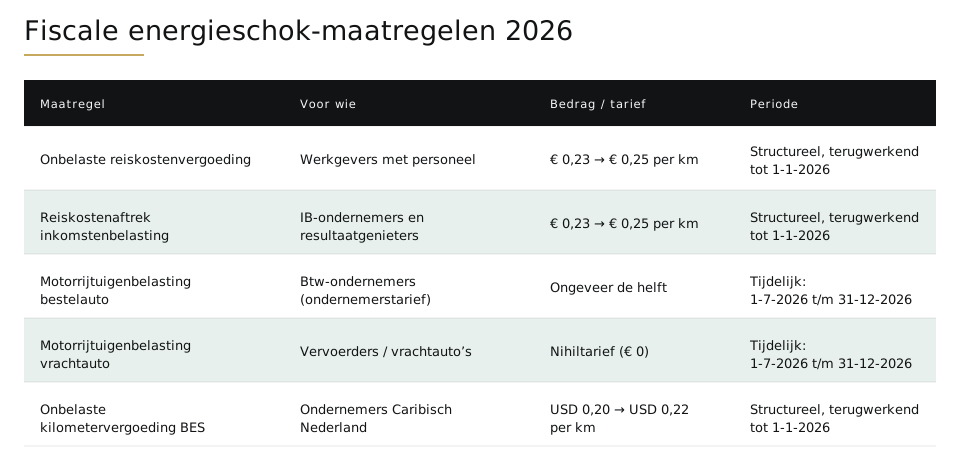
The cabinet introduced five fiscal measures in May 2026 due to the sharply rising fuel prices. For most entrepreneurs, three are significant: the tax-free travel expense reimbursement increases from €0.23 to €0.25 per kilometre (with retroactive effect from 1 January 2026), self-employed individuals can deduct the same €0.25, and the motor vehicle tax (the road tax you pay quarterly for your vehicle) will temporarily decrease for vans on the entrepreneur rate and for lorries. These measures are outlined in an approving policy decision by the Secretary of State for Finance dated 17 May 2026.
In this article
- What do the energy shock measures entail?
- How much will the tax-free travel expense reimbursement increase, and from when?
- I have staff — how do I process the increase for the months that have already passed?
- I am a self-employed person or income tax entrepreneur — what does this mean for my travel expense deduction?
- I drive a van at the entrepreneur rate — how much less road tax do I pay?
- I drive a lorry — is it true that I temporarily do not pay road tax?
- From what moment does the lower road tax apply?
- Do I need to do anything myself, or does this happen automatically?
- Until when do these measures apply?
What do the energy shock measures entail?
It concerns five approvals that anticipate new legislation. An approval is a decision in which the state secretary allows you to deviate from the law in your favour before the law itself has been amended.
For the Netherlands, there are four measures: a higher tax-free travel expense reimbursement for employees, a higher travel expense deduction for income tax entrepreneurs and result enjoyers, a lower road tax for vans at entrepreneur rates, and a lower road tax for lorries. A fifth measure increases the tax-free kilometre allowance for Caribbean Netherlands (Bonaire, Sint Eustatius and Saba). That is stated in the Policy decision on tax measures in response to the energy shock.
According to the cabinet, the reason is the sharp rise in fuel prices due to the war in the Middle East. The measures are intended for groups who find it difficult to avoid the higher costs, as they incur those costs for their work or their business.
How much does the tax-free travel expense reimbursement increase, and from when?
The tax-free travel expense reimbursement increases from € 0.23 to € 0.25 per kilometre, with retroactive effect from 1 January 2026. This is the amount that an employer may reimburse per business kilometre without the employee paying tax on it. Commuting is also included.
The maximum has been € 0.23 since 2024 and is now increasing by € 0.02. For comparison: in 2023 it was € 0.21. The increase applies to every mode of travel for which the exemption applies — so also by public transport, by bicycle or on foot, as confirmed by the Tax Authority.
As an employer, you are not obliged to reimburse more. The measure only increases the amount that you may give tax-free. If you reimburse more than € 0.25 per kilometre, then the part above that amount is taxable income.
The reason for the retroactive effect is enforceability. Two different travel expense rules within the same tax year would make payroll administration unworkable. Therefore, the € 0.25 applies for the whole of 2026, as stated by the Secretary of State in the decision.
I have staff — how do I process the increase for the months that have already passed?
You may still pay the difference of € 0.02 per kilometre tax-free, or correct your previous declarations. Which route is appropriate depends on what you have already reimbursed this year.
Did you reimburse € 0.23 per kilometre (or less) since 1 January 2026? Then you may still pay the extra € 0.02 per kilometre tax-free in a subsequent payroll payment. That is the simplest route, according to the Tax Authority.
Have you reimbursed more than € 0.23 this year and treated the excess as taxable wages? Then you may reduce the wages by € 0.02 per kilometre per declaration period by correcting the payroll declarations for those periods. The decision explicitly allows those correction messages.
I am a self-employed person or income tax entrepreneur — what does this mean for my travel expense deduction?
If you drive for business with a private vehicle, you may deduct € 0.25 per kilometre from your profit instead of € 0.23 — also retroactively to 1 January 2026. This applies to income tax entrepreneurs and to those who derive income from other activities (people who pay tax on income from other work, for example, a freelance job alongside employment).
With that fixed amount per kilometre, you can no longer deduct separate car costs. Fuel, insurance, tolls, and parking are already included in the € 0.25 per kilometre, as explained by the Tax Authority.
The increase to € 0.25 also affects three other fixed deductible amounts in income tax. These are the travel costs for visiting a doctor, hospital or pharmacy (part of the specific healthcare costs deduction), the weekend expenses for transporting a disabled person to and from a care institution, and the donation deduction if a volunteer waives a travel expense reimbursement. For all these items, the same rate of € 0.25 per kilometre will apply from 1 January 2026, as stated in the policy decision.
I drive a van at the entrepreneur rate — how much less road tax do I pay?
About half. From 1 July 2026 to 31 December 2026, a reduced rate applies for vans of VAT entrepreneurs, which effectively halves the vehicle tax. This is confirmed by Entrepreneurs' Square.
The reduced rate only applies if you use the van for business purposes more than incidentally — the same condition that applies to the regular entrepreneur rate. If you are already paying the entrepreneur rate for your van, you fall under the scheme. The exact reduced rate per weight class is listed in the tariff table of the policy decision.
This is a temporary measure for the second half of 2026, not a structural reduction.
I drive a lorry — is it true that I temporarily do not pay road tax?
Yes. For lorries, a zero rate applies from 1 July 2026 to 31 December 2026: you do not pay vehicle tax during that period. That is a rate of € 0, approved in the policy decision.
In practice, this mainly applies to heavier lorries. For lorries with a permitted maximum weight of under 12,000 kilos, a zero rate has already been in effect since 1 July 2026 due to a broader change in road tax; the temporary zero rate therefore mainly makes a difference for lorries of 12,000 kilos or heavier. This distinction clarifies the Tax Authority regarding the changes from 1 July 2026.
From what moment does the lower road tax apply exactly?
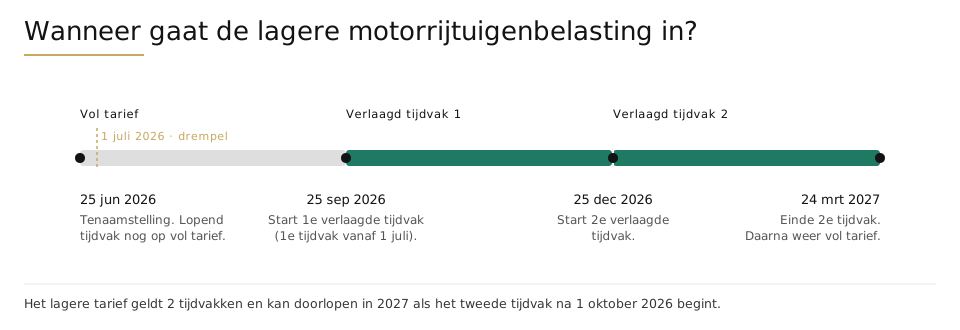
Not automatically from 1 July, but from your next tax period that starts on or after 1 July 2026. The vehicle tax runs per period of three months, and that period starts on the day the vehicle was registered in your name — not on the first day of a quarter.
As a result, the lower rate may start for one vehicle in July and for another only later. The reduced rate applies for two periods. The reason it does not simply run per quarter is stated in Article 83 of the Motor Vehicle Tax Act 1994, which applies the decision here.
If your second period starts after 1 October 2026, the discount continues into 2027 — until the end of that second period. For some vehicles, the lower rate may continue until early 2027, confirms EY in its analysis of the decision.
Do I need to do anything myself, or does this happen automatically?
That varies by measure. The road tax will automatically decrease; the travel cost measures do require an action.
The reduction of the motor vehicle tax for vans and lorries is processed by the Tax Authorities themselves. You do not need to do anything for this; the adjusted rate is visible in the tool Calculate Motor Vehicle Tax, according to Entrepreneurs' Square.
The higher travel expense reimbursement for staff goes through your payroll administration. You can choose whether to pay the extra € 0.02 or process it via a correction message. The higher travel expense deduction as a self-employed person is processed in your income tax return for 2026, by charging € 0.25 per business kilometre instead of € 0.23.
Until when do these measures apply?
The policy decision expires on 1 January 2027. From that date, the measures must be included in regular legislation to remain in effect.
The cabinet includes the measures in the draft Tax Plan 2027, which was submitted to the House of Representatives on Budget Day 2026. The decision is therefore a temporary bridging until that legislative process is completed, as stated in the explanation of the decision.
Note the difference in character between the measures. The higher travel expense reimbursement and travel expense deduction are intended to be structural: they should also remain after 2026. The reduction of the road tax is explicitly temporary and will stop after 31 December 2026 (with the phasing out per period as described above).
Sources
- Policy decision on fiscal measures in response to the energy shock — State Gazette 2026, no. 18302, Ministry of Finance, published 21 May 2026 (signed 17 May 2026).
- Increase in tax-free mileage allowance: how do you process this in the payroll declaration? — Tax Authorities, consulted July 2026.
- Use private transport (travel expense deduction for self-employed) — Tax Authority, consulted July 2026.
- Commercial vehicles temporarily pay less road tax — Entrepreneurs' Square (Chamber of Commerce/Government), consulted July 2026.
- Changes in motor vehicle tax since 1 July 2026 — Tax Authority, consulted July 2026.
- Decision on fiscal measures energy shock — EY Netherlands, tax update, 28 May 2026.
Author(s)

Mirko Kersten
Mirko advises entrepreneurs on their administration, taxation and business structure. He studied accountancy and law, and combines those two backgrounds in his work: the figures and the law behind them. As a result, he writes authoritatively on both fiscal and legal topics.