
In trade and logistics, most vacancies do not arise from growth, but from people leaving. In the research People&Work in trade and logistics 2022 77% of the vacancies were replacement demand. Therefore, those who want to reduce the staff shortage benefit more from retaining people than from recruiting new ones.
In this article
- Why does more recruiting not solve the staff shortage?
- How tight is the labour market in trade and logistics now?
- Does investing in retention really work, or is that just soft talk?
- Why is absenteeism rising, and what can you do about it?
- Is a higher salary enough to retain people?
- Why does strategic HR policy often remain on paper?
Why does more recruiting not solve the staff shortage?
Because most vacancies arise from departures, not from growth. Every employee you recruit and then lose creates a new vacancy. You are mopping with the tap open.
The figures clearly show this. In the research People&Work 2022 by evofenedex, ABN AMRO and Olympia, half of the companies indicated that the number of vacancies had increased. For 77%, it was about replacing existing positions, for 67% about additional capacity, and for 42% about new positions (evofenedex, ABN AMRO & Olympia, 2022). Replacement is therefore the largest source of vacancies.
Recruitment costs money and time, and the result is uncertain. As long as just as many people leave as you bring in, the demand for staff remains equally high. The shortage will only disappear when the outflow decreases. That is exactly why retention (keeping your current employees) is a stronger lever than recruitment.
How tight is the labour market in trade and logistics now?
Less tight than in 2022, but still tense. In the first quarter of 2026, there were 91 vacancies for every 100 unemployed. In 2022, when the report was published, the market was at its tightest.
The tension in the labour market (the ratio of open vacancies to unemployed) has decreased since that peak (CBS, 2026). In trade, transport and hospitality, the number of jobs even fell by 22 thousand in the first quarter of 2026 compared to a year earlier (CBS, 2026). The acute panic of 2022 has therefore somewhat subsided.
However, the shortage is not resolved, and that is due to demographics. The workforce is ageing: more people are retiring than young people are entering. For operational roles such as driver, logistics employee and planner, the demand remains structurally high. The cooling of the figures does not change that underlying pattern.
Vacancies per 100 unemployed (CBS, seasonally adjusted; measured per quarter)
Does investing in retention really work, or is that soft talk?
It works, and there is solid research for it. Work with enough resources — autonomy, support from management, development opportunities — leads to less turnover and more engaged employees who stay. It is not a matter of atmosphere, but of measurable psychology.
The most well-known model behind this is the Job Demands–Resources theory (JD-R). This theory divides work into two types of characteristics: job demands (such as workload and pace) and resources (such as autonomy, support, and development). High job demands exhaust people and ultimately lead to burnout. Too few resources cause people to drop out and leave.Bakker, Demerouti & Sanz-Vergel, 2023).
The core for an employer: resources buffer the job demands. Someone with a heavy workweek can last longer if they have control over their work, are supported, and can develop. Investing in those resources is therefore not "just nice to have" — it is the direct lever on absenteeism and turnover.
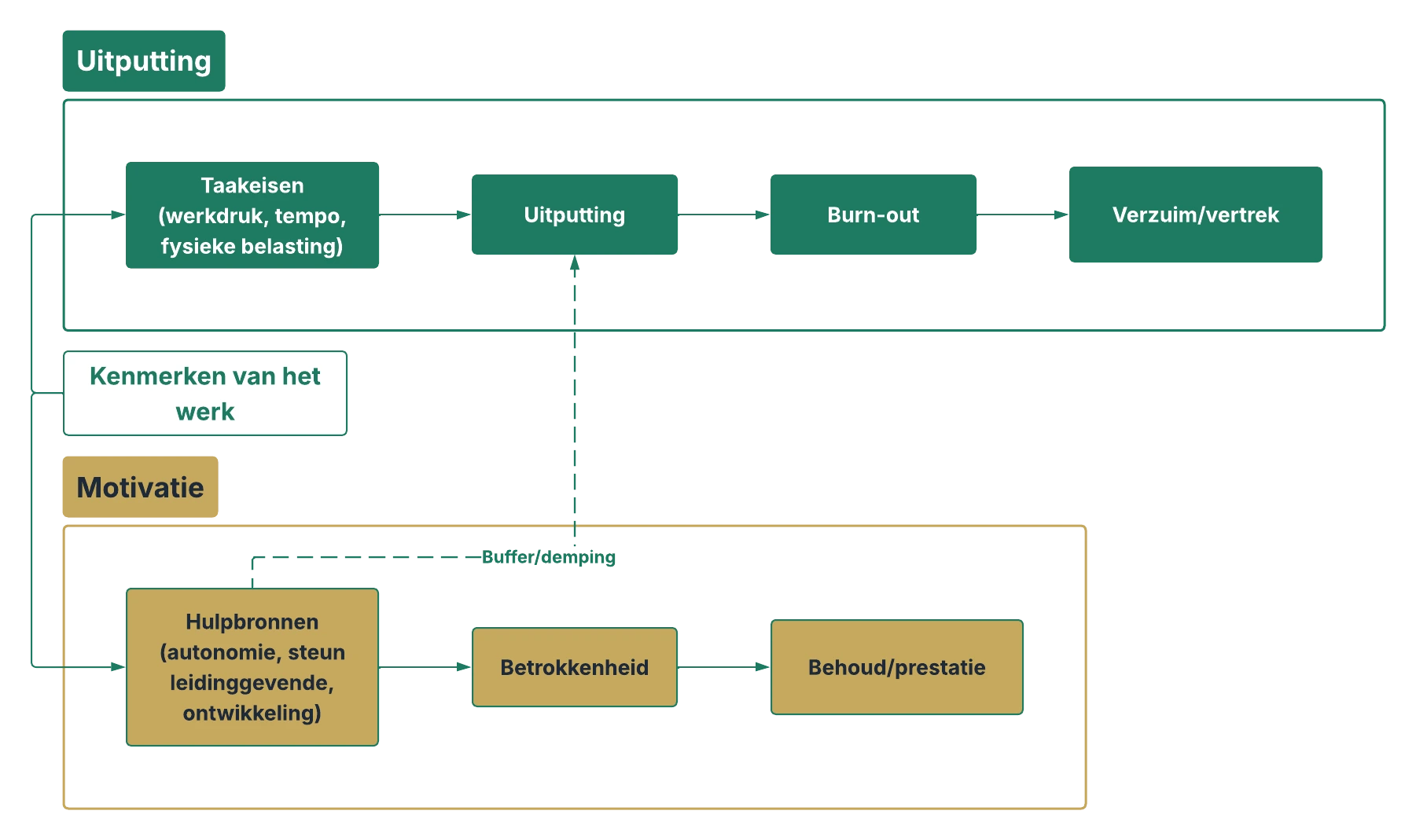
Diagram of the Job Demands-Resources model in which job demands lead to exhaustion and resources lead to engagement and dampen the effect of job demands.
Why is absenteeism rising, and what can you do about it?
Absenteeism is high and moving in the wrong direction. In the first quarter of 2026, absenteeism among employees stood at 5.8%. This is above the long-term average of 5.0% since 1996 and is the highest level in thirty years.
Flu and colds are the most commonly cited reasons, but the work itself plays a significant role. Of the employees who were absent in 2025, 23% said this was entirely or partly due to work. Work pressure is the most frequently mentioned cause (28%), and 9% of those absent cited mental health issues, stress or burnout (CBS, 2026). In the transport and storage sector, the proportion of work-related absenteeism is above average (CBS, 2026).
Here a dangerous cycle emerges. Due to staff shortages, the existing team is on its toes. This high work pressure leads to absenteeism, and that absenteeism puts even more pressure on the people who are still there. Thus, the shortage feeds itself.
What can be done about it? Back to the JD-R model: work pressure is the job demand that exhausts. You reduce absenteeism by alleviating that pressure and by strengthening resources — better planning, clear support from managers and space to recover. Notably, absenteeism in small companies (2.8% in the first quarter of 2026) is much lower than in large ones (6.8%). Shorter lines of communication and greater involvement seem to provide protection (CBS, 2026).
The sickness absence rate in the Netherlands from 1996 to 2026, with a dotted line at the long-term average of 5.0 percent and a peak of 5.8 percent in 2026
Is a higher salary enough to retain people?
No. Salary is necessary to participate, but it does not retain people in the long term. Development, autonomy and a workable balance between work and private life weigh heavier for retention.
Since 2022, salary has indeed become more important in attracting staff, especially due to inflation and rising energy costs. At the same time, a permanent contract has become less decisive, and employers cited a good working atmosphere as the most important condition to be attractive (evofenedex, ABN AMRO & Olympia, 2022). Money does entice people, but it is not what keeps them.
This aligns with the research on engagement. What binds people long-term and energises them are the resources in work: autonomy, support, and the opportunity to grow (Bakker, Demerouti & Sanz-Vergel, 2023). A pay rise that is not accompanied by better work rarely solves a retention problem.
Why does strategic HR policy often remain on paper?
Because the urgency of the day wins over the plan. In 2022, 53% of companies with a mission and vision stated that their HR policy was aligned with it. However, in their actual policy, that connection was hardly to be found.
Strategic personnel policy means that inflow, throughflow, and outflow are arranged in such a way that you have the right people in the right place — now and in the future. In practice, this often does not happen. Time and capacity are most often cited as the reasons why companies do not establish development or employability policies (evofenedex, ABN AMRO & Olympia, 2022). The urgent displaces the important.
What does work is starting small. A large policy plan rarely reaches the finish line; a few concrete steps do. Think of serious onboarding, so that new people do not drop out in the first weeks. Of situational leadership, so that managers under high pressure do not stop directing and delegating. And of a personal development plan that is linked to the goals of the company. Those are exactly the resources that keep people engaged — and they are steps that lie within your own sphere of influence.
That brings it back to the core. The labour market has cooled slightly since 2022, but the problem has not resolved itself: absenteeism is at its highest point in thirty years, and ageing continues to have an impact. In a market where most vacancies are replacement demand, the employee who works for you today is also the employee you will need tomorrow.
Sources
- evofenedex, ABN AMRO & Olympia — Mens&Werk in de handel en logistiek 2022 – HRM-trends, november 2022. Link
- CBS — Spanning op de arbeidsmarkt (Dashboard arbeidsmarkt), cijfers eerste kwartaal 2026. Link
- CBS — Minder vacatures in eerste kwartaal van 2026, 30 april 2026. Link
- Bakker, A. B., Demerouti, E. & Sanz-Vergel, A. — Job Demands–Resources Theory: Ten Years Later, Annual Review of Organizational Psychology and Organizational Behavior, jg. 10, 2023, p. 25–53. Link
- CBS — Ziekteverzuim in eerste kwartaal hoger dan gemiddeld in afgelopen 30 jaar, 4 juni 2026. Link
- CBS — Ziekteverzuim (Dashboard arbeidsmarkt), NEA CBS/TNO, jaarcijfers 2025. Link
Author(s)

Mirko Kersten
Mirko advises entrepreneurs on their administration, taxation, and business structure. He studied accountancy and law, and combines those two backgrounds in his work: the numbers and the law behind them. As a result, he writes authoritatively on both tax and legal subjects.