
A burn-out rarely arises from one busy period. It is the result of long-term distortion between what the job demands of someone (the job demands) and what the job provides in return (resources such as autonomy, support, and appreciation). As an employer, you primarily manage that balance: reducing job demands where possible, and strengthening resources. This is not only good employer practice — it is legally required and it significantly reduces your absenteeism costs.
In this article
- What exactly is a burn-out — and what is the difference between just being tired or feeling down?
- What causes a burn-out according to research?
- What protects against burn-out — and what makes people truly engaged?
- How many workers in the Netherlands have burn-out complaints?
- What does work stress and absenteeism cost an employer?
- What do I need to legally arrange as an employer against work stress?
- What really works to prevent burn-out — and what doesn't?
What exactly is a burn-out — and what is the difference between just being tired or feeling down?
A burn-out is a work-related state of exhaustion, combined with distancing from work (cynicism). It is therefore more than just being tired: it is characteristic that rest and a weekend no longer solve it. The World Health Organization describes burn-out as a result of "chronic work stress that has not been successfully managed".
The WHO describes burnout in the international disease classification (ICD-11) as a work-related phenomenon, not as a medical illness. There are three characteristics: exhaustion, mental distance or cynicism towards work, and the feeling of performing less well. The WHO emphasises that the term only applies to the work context, not to other parts of life (WHO, ICD-11).
In scientific research, two core dimensions are often measured: exhaustion and cynicism (or "mental distance"). This distinction comes from the classical burnout research of Maslach and colleagues (Maslach, Schaufeli & Leiter, 2001).
The difference with depression is important. A burnout is by definition linked to work; a depression plays a broader role in someone's life and is a medical condition. The symptoms may resemble each other, so if in doubt, always have an occupational physician or GP take a look. A manager does not make a diagnosis.
What causes burnout according to research?
Burnout occurs when the job demands are structurally higher than the resources available to cope with them. This is the core of the job demands–resources theory (JD-R), the most used explanatory model for work stress and engagement. High demands without sufficient resources gradually exhaust people — this is called the exhaustion process (Bakker, Demerouti & Sanz-Vergel, 2023).
Job demands are all aspects of work that drain energy: high workload, time pressure, emotionally heavy contact, unclear roles. Resources are everything that helps to do the work and motivates: autonomy (being able to determine how you work), support from colleagues and management, feedback, development opportunities. The theory states: it is not about the demands or the resources separately, but about the relationship between them.
Not every job demand is equally harmful. Research distinguishes between hindering demands (such as bureaucracy, role ambiguity, and conflicts) and challenging demands (such as responsibility and tough projects). Hindering demands primarily drain energy; challenging demands also cost energy but can simultaneously motivate (Crawford, LePine & Rich, 2010). For an employer, this is a useful distinction: eliminate the hindrances, and be more cautious about simply removing challenges.
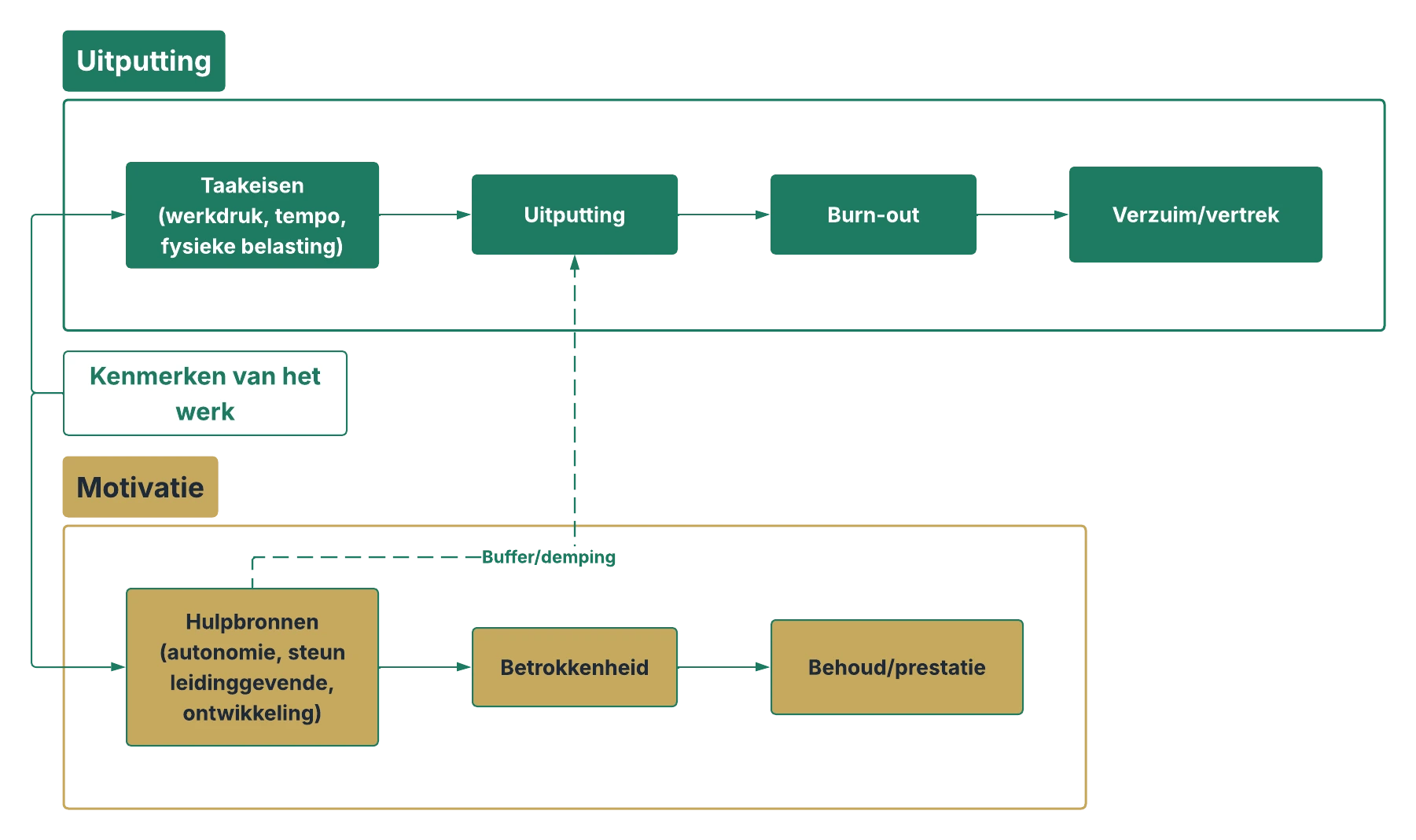 Diagram of the job demands–resources theory with two routes: job demands lead to burnout via exhaustion, resources lead to engagement via motivation.
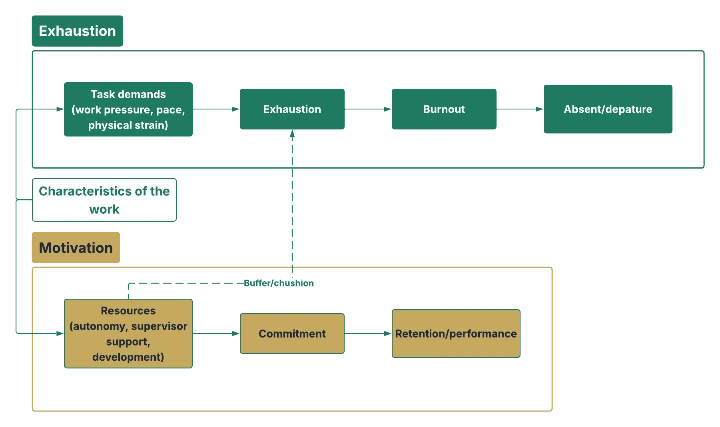 Diagram of the job demands–resources theory with two routes: job demands lead to burnout via exhaustion, resources lead to engagement via motivation.
What protects against burnout — and what makes people engaged?
Resources protect against burnout and are the driving force behind the opposite: engagement. Engagement is a positive work state of energy (vigor), dedication (dedication), and absorption in work (absorption). Where burnout is exhaustion and detachment, engagement is energy and involvement (Bakker, Demerouti & Sanz-Vergel, 2023).
Resources work in two ways. They buffer the damage of high demands (the buffering effect), and they generate motivation on their own. A long-term meta-analysis shows that resources such as autonomy, support, and feedback predict engagement over time — it is therefore not a snapshot but a structural effect (Lesener, Gusy, Jochmann & Wolter, 2020).
In addition to work-related factors, personal resources also count: self-confidence, optimism, resilience. These enable someone to cope better with high demands. Work and personal resources usually reinforce each other: those who receive support and space build confidence, and that confidence makes work more manageable.
How many workers in the Netherlands have burnout complaints?
Approximately 1 in 5 employees had burnout complaints in 2025. In the National Survey on Working Conditions (NEA) by CBS and TNO, 20.7% of employees reported experiencing psychological fatigue from work several times a month or more. This is higher among women (23.5%) than among men (18.0%) (RIVM, Mental Health Monitor / NEA, reporting year 2025).
Among self-employed entrepreneurs, the share is lower: 11.8% in 2025, according to the Self-Employed Survey on Working Conditions (ZEA). So even as a director or freelancer, you are not immune — over 1 in 9 has complaints (RIVM / ZEA, reporting year 2025).
Complaints have been increasing for years. Among employees, the percentage rose from 13.4% in 2015 to 20.7% in 2025, with the strongest growth among women (RIVM / NEA). Complaints are not evenly distributed across sectors: in education, the share was highest (around 25%), in agriculture the lowest (around 12%) (TNO/CBS, NEA 2024).
Line graph showing the increase in burnout complaints between 2018 and 2025, up to 20.7% among employees and up to 11.8% among self-employed entrepreneurs.
What does work stress and absenteeism cost an employer?
Absence due to work stress is a significant, and growing, cost for employers. More than half of the total wage payment during absence is due to psychosocial workload — work pressure, work stress, and undesirable behaviour. In 2023, this amounted to approximately 4.9 billion euros in employer costs (TNO, Arbobalans).
Mental health issues are costly because people are often off work for a long time. Those who are absent due to mental health issues, overstretching, or burnout typically miss around 63 working days — longer than for almost any other cause. In three-quarters of those cases, the employee indicates that work is (partly) the cause (TNO, Arbobalans).
In the case of illness, you continue to pay wages for a long time. The law requires you to pay a sick employee at least 70% of their wages for a maximum of 104 weeks (two years). If you do not cooperate sufficiently with reintegration, the UWV can extend that period by a year (UWV, wage payment during illness). Therefore, one long-term absence of an employee with a burnout affects your results for two years.
On the other hand, there is the benefit of the opposite. Engaged employees demonstrably perform better and take less sick leave. A meta-analysis of over 139,000 workers found a strong positive correlation between engagement and task performance, and a negative correlation with absenteeism (Neuber, Englitz, Schulte, Forthmann & Holling, 2022). Therefore, managing the balance is not a cost, but an investment with returns.
What do I need to legally arrange as an employer against work stress?
You are legally required to implement policies against psychosocial workload (PSA) — the stress from work pressure and unwanted behaviour. This is stated in the Working Conditions Act. You must prevent or limit PSA where it poses a risk in your organisation (Working Conditions Portal, Ministry of Social Affairs and Employment).
The starting point is the risk inventory and evaluation (RI&E): a mandatory document in which you map the risks in your company, along with an action plan. Work pressure and work stress explicitly belong in this. Your PSA policy follows from the RI&E (Working Conditions Portal).
This is not a non-binding paperwork exercise. If you do not have an up-to-date RI&E or no PSA policy, the Dutch Labour Inspectorate can intervene and impose fines (Entrepreneurs' Square, Government.nl). It is precisely smaller companies without an RI&E that lag behind on this.
The legislator speaks the language of research here. The measure that employers most often take against work stress is to give employees more autonomy (TNO) — and autonomy is precisely one of the resources that protects against burnout in the JD-R theory. What the law requires and what science shows to be effective point in the same direction.
What really works to prevent burnout — and what does not?
It works to adjust the balance itself: reducing job demands and strengthening resources. Loose "wellness" actions without that core rarely address the cause. The strongest approach combines two tracks: restructuring work (from above) and allowing employees to adjust their work themselves (from below).
From above, it is about job design: realistic work pressure, clear roles, enough autonomy, and support from the manager. This is the aspect that you as an employer have direct control over and that the law also requires of you.
Job crafting works from the bottom up: employees adjust their own work by seeking more resources, looking for challenges, and reducing hindering demands. A meta-analysis of 14 intervention studies shows that training in job crafting actually increases behaviour and enhances engagement. That same study also calculated a demonstrable monetary value: less lost production and lower costs (Oprea, Barzin, Vîrgă, Iliescu & Rusu, 2019). Other review research confirms that job crafting is associated with greater engagement and better performance (Rudolph, Katz, Lavigne & Zacher, 2017).
Interventions aimed at engagement work, but be realistic about the scale. A meta-analysis found a small but positive effect, with group interventions yielding the most (Knight, Patterson & Dawson, 2017). Translated into practice: do not expect a miracle cure from one training session, but a structural effect from repeated, team-oriented work on the balance.
And the entrepreneur or director themselves? The same principles apply. Those who do not limit their own job demands and organise too few resources (support, help, autonomy over the agenda) run the same risk. Job crafting and consciously managing your energy also apply to yourself (Bakker, Demerouti & Sanz-Vergel, 2023).
This is a sensitive topic. If you notice persistent exhaustion, gloominess, or the feeling of not being able to cope in yourself or in an employee, involve an occupational physician, general practitioner, or other professional. Noticing and referring is wiser than making a diagnosis yourself.
Sources
- Bakker, A.B., Demerouti, E. & Sanz-Vergel, A. (2023). Job Demands–Resources Theory: Ten Years Later. Annual Review of Organizational Psychology and Organizational Behavior, 10, 25–53. (open access) — https://doi.org/10.1146/annurev-orgpsych-120920-053933
- World Health Organization (WHO) (2019). Burn-out as an "occupational phenomenon": International Classification of Diseases (ICD-11). — https://www.who.int/news/item/28-05-2019-burn-out-an-occupational-phenomenon-international-classification-of-diseases
- Maslach, C., Schaufeli, W.B. & Leiter, M.P. (2001). Job burnout. Annual Review of Psychology, 52, 397–422. — https://doi.org/10.1146/annurev.psych.52.1.397
- Crawford, E.R., LePine, J.A. & Rich, B.L. (2010). Linking job demands and resources to employee engagement and burnout: a theoretical extension and meta-analytic test. Journal of Applied Psychology, 95, 834–848. — https://doi.org/10.1037/a0019364
- Lesener, T., Gusy, B., Jochmann, A. & Wolter, C. (2020). The drivers of work engagement: a meta-analytic review of longitudinal evidence. Work & Stress, 34, 259–278. — https://doi.org/10.1080/02678373.2019.1686440
- Neuber, L., Englitz, C., Schulte, N., Forthmann, B. & Holling, H. (2022). How work engagement relates to performance and absenteeism: a meta-analysis. European Journal of Work and Organizational Psychology, 31, 292–315. — https://doi.org/10.1080/1359432X.2021.1953989
- Knight, C., Patterson, M. & Dawson, J. (2017). Building work engagement: a systematic review and meta-analysis investigating the effectiveness of work engagement interventions. Journal of Organizational Behavior, 38, 792–812. — https://doi.org/10.1002/job.2167
- Oprea, B., Barzin, L., Vîrgă, D., Iliescu, D. & Rusu, A. (2019). Effectiveness of job crafting interventions: a meta-analysis and utility analysis. European Journal of Work and Organizational Psychology, 28, 723–741. — https://doi.org/10.1080/1359432X.2019.1646728
- Rudolph, C.W., Katz, I.M., Lavigne, K.N. & Zacher, H. (2017). Job crafting: a meta-analysis of relationships with individual differences, job characteristics, and work outcomes. Journal of Vocational Behavior, 102, 112–138. — https://doi.org/10.1016/j.jvb.2017.05.008
- RIVM, Mental Health Monitor — Burnout complaints (source: National Survey on Working Conditions and Self-Employed Survey on Working Conditions, CBS/TNO), reporting year 2025. — https://www.rivm.nl/mentale-gezondheid/monitor/werkenden/burn-out-klachten
- TNO/CBS, National Survey on Working Conditions 2024 and factsheets work stress / Arbobalance. — https://publications.tno.nl/publication/34644230/blkHP7m9/TNO-2025-nea.pdf and https://www.tno.nl/en/newsroom/2022/11/employers-work-pressure-work-related-risk/
- Arboportal (Ministry of Social Affairs and Employment). Psychosocial workload (PSA). — https://www.arboportaal.nl/onderwerpen/psychosociale-arbeidsbelasting
- Entrepreneurs' Square (Government.nl / KVK). Creating policy against psychosocial workload. — https://ondernemersplein.overheid.nl/personeel/arbo-en-gezondheid/beleid-tegen-psychosociale-arbeidsbelasting-maken/
- UWV. Sick pay during illness. — https://www.uwv.nl/nl/ziek/loondoorbetaling