
Explanation:
Many of the studies in this article are in English. In those studies, terms such as accountant, bookkeeper and accounting firm are often used for different types of financial service providers. These concepts do not exactly match the Dutch professional titles. Where we write “accountant” or “bookkeeper” in this article, it may also refer to an administrative office or other financial advisor.
You can expect two things from your accountant: the figures in order, and advice about your business. In practice, most entrepreneurs only receive the former. This is rarely because the accountant has nothing to say. It is because advice only comes to the table when you ask for it — and most entrepreneurs do not know what to ask.
In this article
- What does an accountant typically do — and where does that end?
- Why do I get figures, but no advice?
- What advice can I expect for my type of business?
- Does advice from your accountant actually yield anything?
- What questions can I ask myself to get more from my accountant?
- Does digitalisation change what I can expect from my accountant?
What does an accountant do as standard — and where does that stop?
As standard, an accountant handles your compliance: keeping the administration, the VAT return (the periodic declaration of turnover tax), the annual accounts, and the tax returns. This is mandatory work and it must be correct. Advice on how to improve your business does not automatically come with that.
The line between "normal work" and "advice" is also vague. Research among Norwegian accounting firms shows that firms themselves disagree on where that line lies: some consider the tax calculation at the end of the year as advice, while others see it as normal work (Åmo & Henk, 2025). What one firm calls "extra" is included by another. This means for you: do not assume what is "usual", but ask what is included in your package.
Offices also build their advisory capacity step by step. They start with technical accounting questions and only later expand into legal advice, internal operations, and ultimately strategic roles (Åmo & Henk, 2025). An office that is only strong in the basics simply cannot provide you with the strategic conversation you are looking for. This is not due to unwillingness, but to capacity.
Why do I get figures, but no advice?
Because most accountants advise reactively: they only come up with advice when discussing the periodic figures with you, and not spontaneously outside of that. Giving advice takes time, and some offices feel uncomfortable with it or do not see it as their task (Åmo & Henk, 2025). The result: you receive neat figures, but no one tells you what to do with them.
There is a second problem. Entrepreneurs have to ask for advice themselves, but often do not know what to ask (Åmo & Henk, 2025). You can see that you want more, but you cannot formulate the question precisely. Thus, valuable advice remains on both sides: the accountant waits for your question, you do not know how to ask it.
This pattern is not unique to one country. A large literature review shows that the gap between what offices can offer and what SMEs need recurs in study after study (Ali & Mustafa, 2023). It is therefore a structural feature of the market, not an incident at your office.
What advice can I expect for my type of business?
That depends on where your business stands. The research distinguishes three types of entrepreneurs and four levels of advice, and they fit together (Åmo & Henk, 2025). A starter needs something different than an established company, and a growth company needs something different than both.
The four levels of advice range from basic to strategic. The first level is accounting technique: how do I record travel expenses, how do I report hours, how do I check my tax return. The second is legal framework: setting up a limited company, terminating a business, transferring ownership. The third is internal organisation and basic management: preparing budgets, control parameters, setting up digital processes. The fourth is external controller: the office is involved in complex decisions, such as assessing suppliers or guiding a liquidation (Åmo & Henk, 2025).
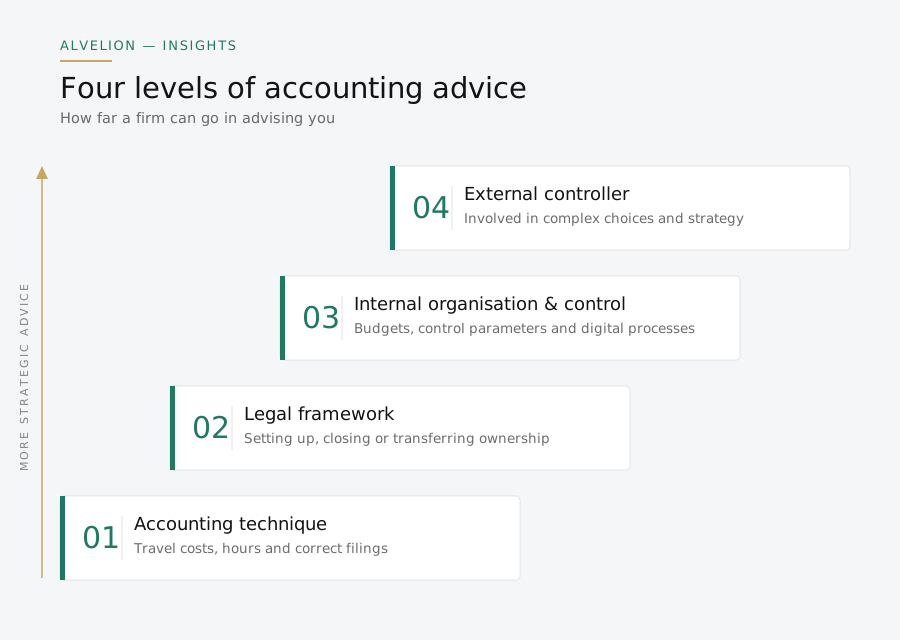
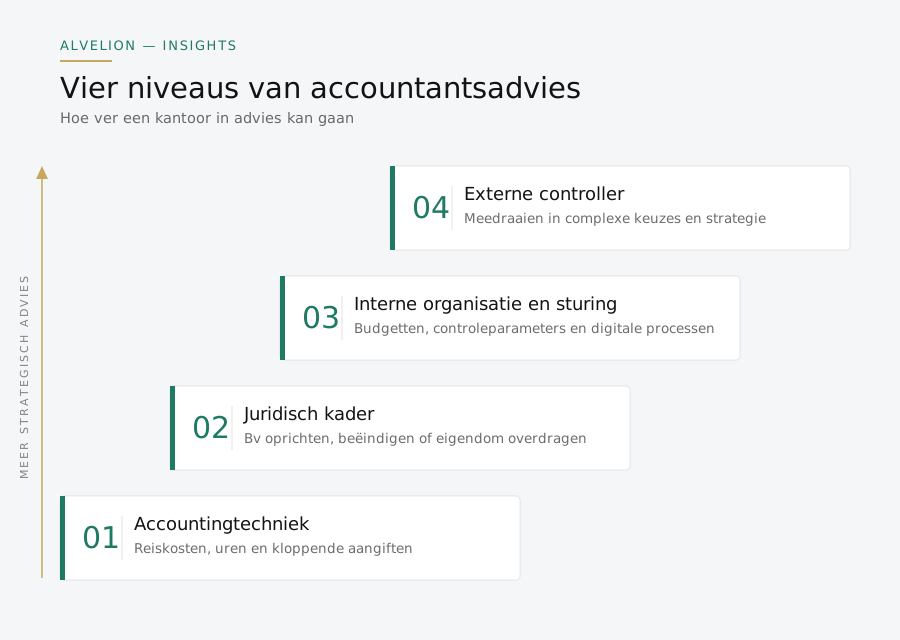
The names of the advisory levels are translated from English-language research. Therefore, they do not always correspond one-to-one with Dutch job titles or functions.
Which level suits you depends on your type of business. A young, inexperienced company primarily needs basic advice: how do I register my business, how do I create a budget, how do I measure if I am making a profit (Åmo & Henk, 2025). An experienced, well-run company needs little routine advice, but often encounters specific issues such as business succession or a pension scheme. A professional growth company wants the highest level: advanced advice on tax structures, ownership structures and various growth scenarios (Åmo & Henk, 2025).
Type of entrepreneur | Level of advice | Examples |
Small and inexperienced | Accounting technique | accounting, VAT, payroll administration, tax returns and travel expenses. |
Experienced and well-managed | Legal framework / Internal organisation and management | the establishment or cessation of a business, a different legal form and a change of ownership. budgets, internal controls, reporting, digital systems and improving work processes. |
Professional and growth-oriented | Internal organisation and management / External controller | strategy, growth, investments, cost control and important decisions |
Dutch entrepreneurs are asking exactly this. Research from Leiden University and the industry organisation SRA shows that especially smaller entrepreneurs have a need for strategic advice for the long term, and place great value on industry knowledge and an advisor who thinks proactively (Accountant.nl, 2013). So the demand is there. The gap lies in the offer that you typically receive.
Does advice from your accountant actually yield anything?
Yes. There is empirical evidence that entrepreneurs who purchase advice from their accountant perform better. A study among 380 Australian SMEs found a positive correlation between voluntarily purchasing business advice and the performance of the company (Carey, 2015). Advice is therefore not just a cost; it is associated with a better-performing business.
The important word is voluntary. The effect is seen in entrepreneurs who actively seek out and purchase advice — not in advice that is just included by chance (Carey, 2015). This relates to the problem of the reactive accountant: those who wait for advice to come on its own are likely to miss the part that yields the most.
The effectiveness does depend on the relationship. Advice is most helpful when there is trust and when the advice is tailored to your situation, not based on a general checklist (Åmo & Henk, 2025). An accountant who knows your figures and your industry can point you to solutions you may not have thought of. That knowledge is the difference between general tips and advice that truly helps you.
What questions can I ask myself to get more from my accountant?
Because most accountants are reactive, the initiative lies with you. Good news: you don’t need to know what advice you need — you just need to ask the right questions. The best time is during the discussion of the periodic figures, as your accountant is already looking at your numbers (Åmo & Henk, 2025).
A few questions that elevate the conversation from figures to advice:
- Where do I deviate this year from last year, and what explains that? Deviations compared to previous periods are the starting point of almost every meaningful advice conversation (Åmo & Henk, 2025).
- How do I perform compared to other companies in my industry? Your accountant sees more companies like yours and can benchmark you against them.
- What costs can I reduce, and what opportunities am I missing? This is the classic "reduce costs, increase income" conversation that firms will have if you ask for it (Åmo & Henk, 2025).
- What risks do you see in my figures that I don’t see myself? Accountants can identify issues you didn’t know you had.
- What would you do if this were your business? This question forces the shift from reporting to collaborative thinking.
The core: your accountant often holds valuable knowledge, but only shares it when you open the door. One concrete question per conversation changes your accountant's role from administrator to advisor.
Does digitalisation change what I can expect from my accountant?
Yes. Because figures are now available in real-time, your accountant can advise you more quickly and accurately than before (Åmo & Henk, 2025). You no longer have to wait until after the financial year to know where you stand. This enables decisions based on facts at the moment they matter.
Digitalisation also shifts where your accountant's time goes. Routine entries take less time, leaving more room for advice and planning (Åmo & Henk, 2025). For you, this means: if your office is still mainly focused on data entry, it is lagging behind what is technically possible.
Digitalisation has also become a criterion for choice for Dutch entrepreneurs. When choosing an accounting firm, the level of digitalisation weighs into the decision (Accountant.nl, 2013). At the same time, digitalisation shifts part of the responsibility: data is in the cloud, but the question of who is responsible for data quality and security becomes sharper (Åmo & Henk, 2025). More speed and insight therefore come with a new requirement: clear agreements on who is responsible for what.
Sources
- Åmo, B.W. & Henk, O. (2025). Accounting firms as business advisors: SME's expectations and accounting firms' capabilities. In: Accounting and Auditing Small and Medium-Sized Practices (chapter 9). Routledge / Taylor & Francis. Open access (CC-BY-NC-ND). taylorfrancis.com
- Carey, P.J. (2015). External accountants' business advice and SME performance. Pacific Accounting Review, 27(2), 166–188. emerald.com
- Ali, Z. & Mustafa, G. (2023). On accounting firms serving small and medium-sized enterprises: A review, synthesis and research agenda. Australian Accounting Review, 33(3), 227–332. onlinelibrary.wiley.com
- Accountant.nl (2013). SME entrepreneur wants clarification of figures and strategic advice from accountant — about the research from Leiden University and SRA into the wishes of the SME entrepreneur. accountant.nl
Author(s)

Mirko Kersten
Mirko advises entrepreneurs on their administration, taxation and business structure. He studied accountancy and law, and combines those two backgrounds in his work: the figures and the law behind them. As a result, he writes authoritatively on both tax and legal subjects.